We manufacture our own concrete septic tanks and distribution boxes right here in Langley, and we stock the poly tanks, pump chambers, and accessories you need to round out a complete wastewater system. Whether you are a homeowner replacing an aging tank, a builder speccing a new lot, or a contractor sourcing parts for a client, this page is where you start narrowing down what belongs on your site.
The short answer: it comes down to site access, soil conditions, and what your drain field elevation looks like relative to your house. If a crane or excavator can reach your install site and your soil holds groundwater, a concrete tank is usually the sturdier long-term choice. If access is tight, your property sits on corrosive or acidic soil, or you are doing a single-person install, a poly tank goes in faster and lighter. If your drain field sits uphill or a long distance from the tank, you will need a pump chamber in the mix regardless of which tank you choose.
We do not expect every customer to arrive knowing which of these fits their project. That is what our team is for. Call us with your site details and we will walk through it with you before you order anything.
Our concrete tanks are cast onsite at our Langley facility, so what you order is what we pour, cure, and deliver, not a product trucked in from somewhere else. We offer both single-chamber and two-chamber configurations across a range of sizes to fit residential, commercial, and rural applications. Two-chamber tanks are typically specified where local regulation or site conditions call for extra settling capacity before effluent moves to the drain field, so ask us which configuration your project needs before you order. Concrete holds up well against ground movement, root pressure, and the kind of surface loading you get from vehicles or heavy equipment parked nearby, which is why it remains the default choice for a lot of BC properties.
Septic Tank PDF Drawings
Poly tanks earn their spot on tight lots where a crane cannot maneuver, on properties with corrosive or acidic soil, and on jobs where a smaller crew needs to place the tank without heavy equipment. Because they are moulded as a single watertight piece with Polylok access points built in, there are fewer seams for groundwater to work its way in. They are not the right call everywhere. On sites with high water tables, a lighter tank can shift out of position unless it is installed and backfilled correctly, so proper bedding and anchoring matter more with poly than with concrete.
Poly Tank PDF Drawings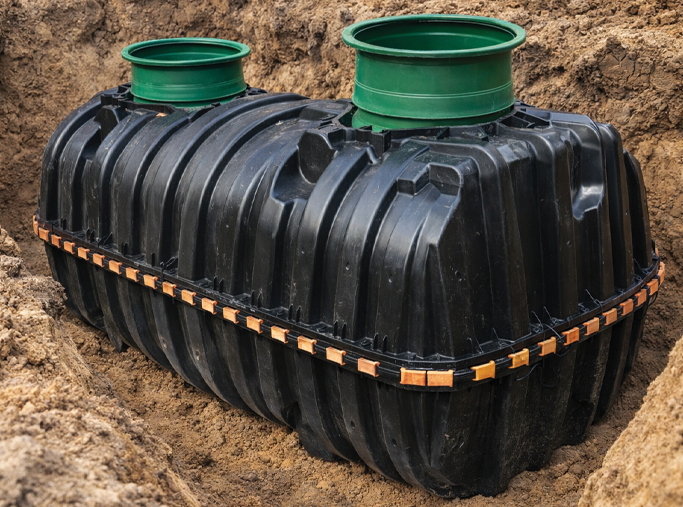
A pump chamber is not a substitute for a septic tank. It is the piece that moves already-treated effluent from the tank to a drain field that sits above it or too far away for gravity to handle on its own. If your property has a basement below street level, a drain field on higher ground, or a run long enough that flow slows to a crawl, you need a pump chamber built into the system. Ours are sized around riser access and pump and control integration, so servicing the pump later does not mean digging up the whole chamber.
Pump Chamber PDF Drawings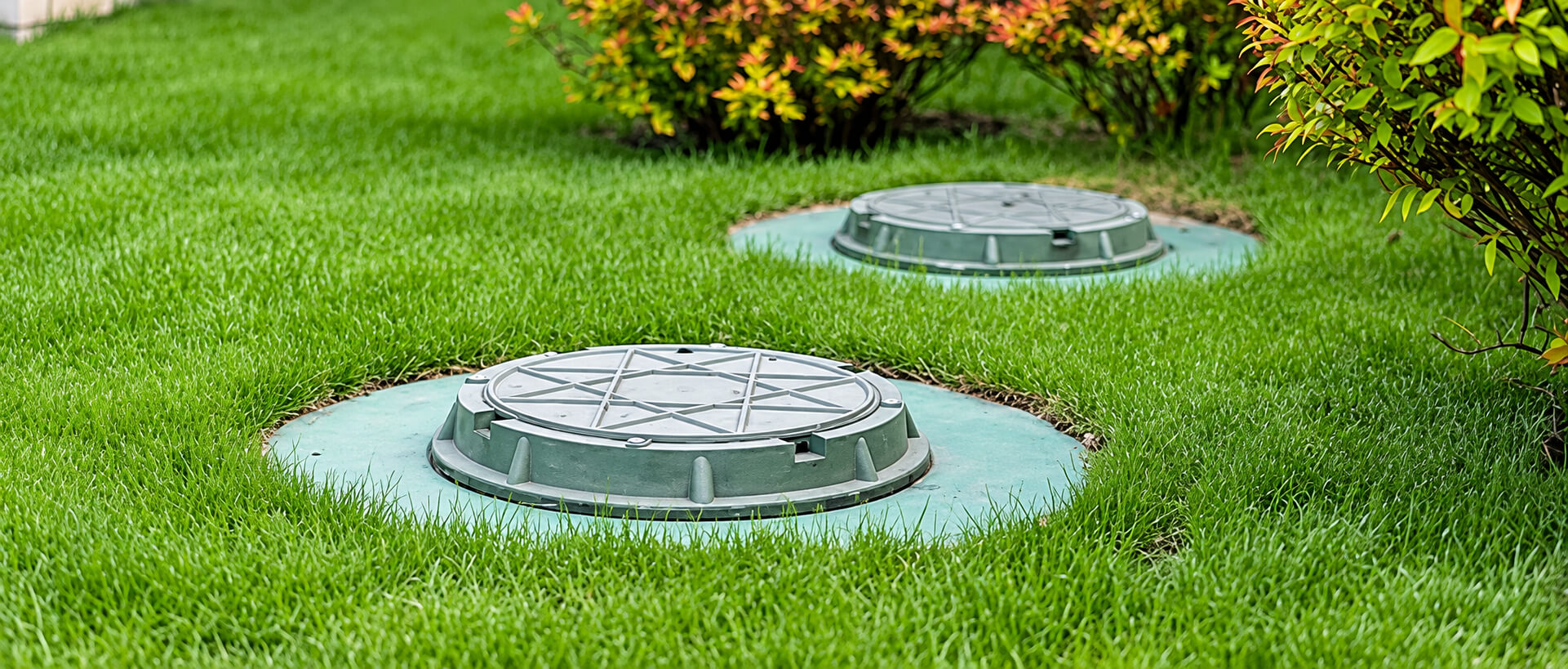
Not every project needs a full system. If you are replacing an effluent filter, adding a riser extension, or swapping out a distribution box, our online store carries the individual parts and accessories to do it yourself. If you are not sure which part fits your existing setup, reach out before you order. Our team would rather answer a quick question upfront than have you order the wrong fitting.
Shop Parts & AccessoriesA septic tank is where wastewater separates into solids, liquids, and scum, and where bacteria break down the solids over time. A pump chamber comes after the tank and only moves already-treated effluent onward to the drain field when gravity alone cannot get it there.
It depends on your site. Concrete handles high groundwater, heavy surface loading, and long-term ground movement better. Poly is lighter, faster to install, and holds up well in corrosive soil or tight-access sites. Call us with your site conditions and we can steer you toward the right one.
Yes. Poly tanks are fitted with the same style of riser access as our concrete tanks, so a pumping service can locate and access the tank the same way, provided the risers were installed to grade.
Most properties in BC need a permit from a health authority before a sewerage system is constructed, altered, or repaired, and the plans need to come from an authorized person such as a Registered Onsite Wastewater Practitioner. We can point you toward next steps, but the permit itself has to come through that process.
Sizing comes down to your household's bedroom count and expected water use, along with any minimums your local health authority sets. Rather than guess from a size chart alone, give us a call with your property details and we will help you land on the right capacity.
Poly tanks are lighter and easier to maneuver than concrete, which is part of why we carry them for self-install customers. That said, placement, bedding, and hookup still need to be done correctly to avoid shifting or leaks, so lean on our team or an installer if any part of the process is unfamiliar.
The wrong tank material or a missing pump chamber can mean early failures, extra excavation later, or a system that cannot keep up with your household's flow. That is exactly why we would rather talk through your site with you before you order than have you guess from a page like this one.

Delivery Options
Available

Great Selection
of Products

Friendly Expert
Advice
Whether you are looking to replace a single part or update your entire septic system by yourself, we carry everything you need to get your septic system up and running. Our expert team members will always take the time to answer any questions you might have about our products, so you can rest assured that you will be receiving expert advice alongside high-quality products and solutions.
Buy Online

